First Flight
For the first flight, no matter what your skill level, it is advisable to limit the control movements. A badly adjusted glider (wrong CG and excess control surface movement) is totally unflyable. I suggest that dual rates are used to progressively test more active manoeuvres. Despite its simplicity, flying the Pibros is not for the beginner, as it needs sharp reflexes and good co-ordinated flying skills.
A computerised transmitter or one with at least elevon mixing is essential for the Pibros. A mechanical mixer might work, but that extra weight would prove detrimental to flight characteristics.
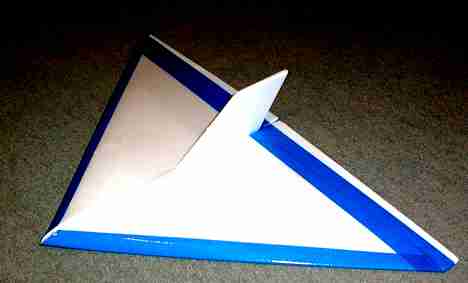
Launching
A gentle throw is the key. The Pibros has a very wide flight envelope and just an easy launch is required. You can hold it by the wingtip and just throw it forward, it stabilises almost immediately. The key is NOT to input to much control and if you do stall and drop a wing do NOT input opposite aileron, it will just rotate to a stall on that side in the blink of an eye. To recover from a dropped wing, just wait a second or two and it will recover pretty much all by itself, just a little bit of up elevator and you are on your way.
Landing
To land the Pibros, all you need to do is to point it towards a ground target and when you are near your position just pull up. Hand catches are really easy. With practise you can land on a dime or a pound or a franc or Marc or Paso’s or whatever you local worthless small coin is.
Some Things to Try
Rapid Take Off - whatever the wind conditions. Do a vertical dive at a target 1.5m from the ground, pull up quickly and the glider will break instantly and gently land (practice for precision).
Flying Backwards - slow down slowly with the glider inverted and facing into the wind, push progressively harder on the down elevator
Flat Spins - slow down, apply full aileron and full up elevator simultaneously.
Wind Conditions
The Pibros has been tested in gusts of up to 70kph and has proven its ability despite its low wing loading. In heavy winds (35Knots on the San Francisco coast at Davenport) I have even ballasted the Pibros with up to 250g of sheet steel ballast taped to the underside of the wing exactly over the C of G. This enabled it to penetrate the wind and fly exceptionally well.
The central positioning of the radio components and extremely low inertia of the craft avoids any serious breakage through impact with the ground. You can therefore get into aerial fights, synchronised group flying etc without fear. We even launch them stacked 4 or 5 high in a single group. Great to try and figure out which one in yours !
Lifespan (!) ...
Experience has shown that the lifespan of the Pibros is quite short because one is tempted to try anything with it. Even though it can withstand serious impact, damage is unavoidable during some crashes. It is easily reparable on the ground with some tape, but once the Pibros has been damaged beyond a certain point, its flying prowess will taper off rapidly.